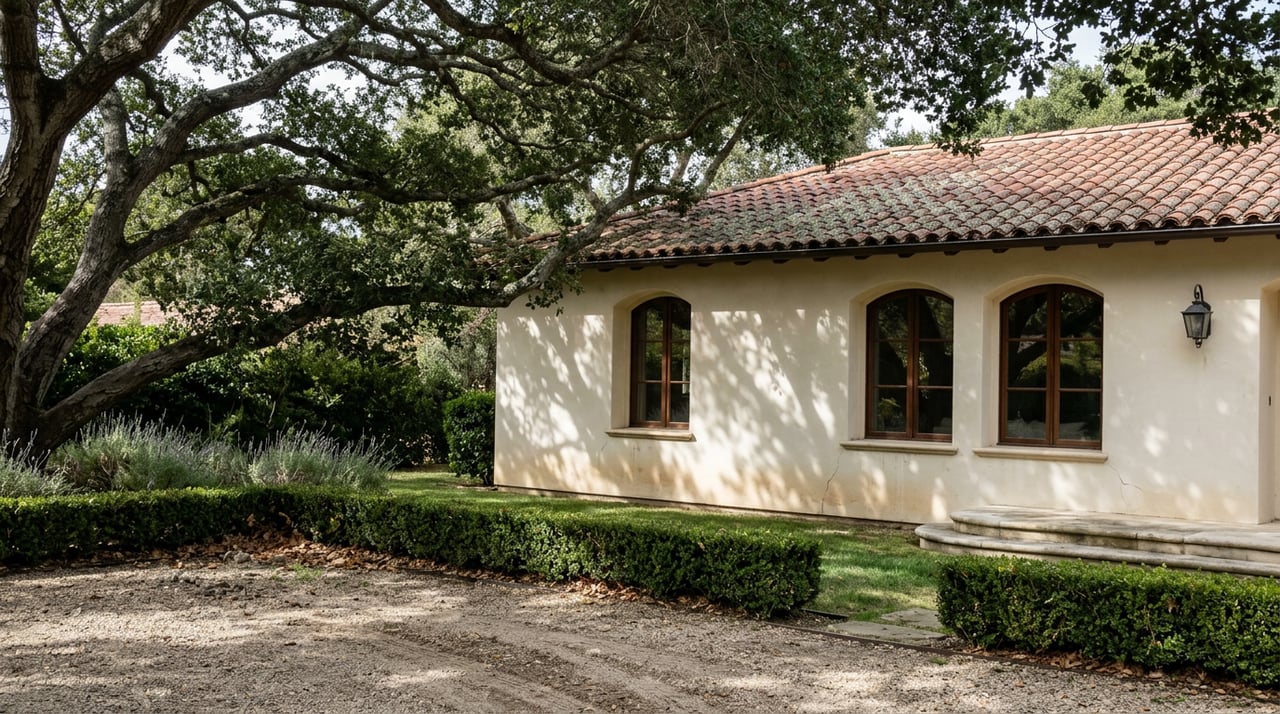
Atherton Heritage Tree Ordinance and Your Building Permit
September 24, 2026
September 24, 2026
The owners of a property on Selby Lane had already cleared the hardest part, or so it seemed. Atherton's Town Arborist had signed off on removing eleven heritage trees across the lot, all of them dead or dangerous, no hearing required. The design called for a home with two garages flanking the front entry, a layout meant to buffer a busy street from a quiet rear yard. One cedar stood in the way of the second garage.
That single tree went to the Planning Commission. Staff found the cedar in moderate health, not declining, not a safety hazard, just inconveniently placed. Their recommendation: keep it. The commission agreed, citing language from Atherton's own General Plan about preserving a scenic, rural, thickly wooded residential area, and found that the applicant hadn't shown there was no other place to put the garage. The design had to change. The tree stayed.
That case, on file with the Town of Atherton, is the clearest evidence of something buyers and sellers routinely miss when they price a remodel or a teardown in this town: the acre count on the listing sheet tells you what you can legally build. It does not tell you what you can actually build, because a single protected tree can override a finished design regardless of how many other trees on the same lot were already approved for removal.
Atherton's heritage tree protections, codified in Chapter 8.10 of the town's municipal code, split into two tracks, and the difference matters more than most buyers realize before they own the lot.
Any native oak, coast live oak, valley oak, or black oak, is protected once its trunk reaches 48 inches in circumference (roughly 15.2 inches in diameter), measured 54 inches above natural grade. Location on the lot doesn't matter. An oak that size standing in the exact center of your intended building footprint is just as protected as one at the property line.
Other species only trigger protection if they meet that same circumference threshold and sit outside the main buildable area, meaning in a setback. A non-oak tree inside your buildable envelope can generally come down without a permit. A non-oak tree of the same size sitting in a side yard cannot.
This is why the Selby Lane cedar mattered even though the applicant had already won approval to remove eleven other trees. Those eleven were dead or dangerous, a determination the Town Arborist can make administratively. The cedar was healthy. Healthy heritage trees don't get evaluated on convenience to a floor plan. They get evaluated against the General Plan's intent, and the town's standing position is that the tree stays unless the applicant proves there's genuinely nowhere else to build.
Buyers who assume a heritage tree removal is a quick administrative step are budgeting for the wrong process. If a tree is confirmed dead or dangerous, the Town Arborist can approve removal directly. If it isn't, the application goes to the Planning Commission, which meets on the fourth Wednesday of each month, and the review adds real time to a project.
| Step | Typical cost or timeline |
|---|---|
| Planning Commission application fee | $750 |
| Certified arborist report (required for the application) | $400 to $700 |
| Replacement planting (2:1 or 3:1 ratio, per commission discretion) | $3,000 to $8,000+ |
| Planning Commission review, if a hearing is required | Roughly 6 to 10 weeks |
| Full permitting for new construction with heritage tree review | 3 to 8 months, longer with complex tree situations |
| Civil penalty for unauthorized removal or damage | 50% of the tree's appraised value |
The last line is the one that changes behavior. Mature oaks on Atherton estates are commonly appraised between $50,000 and $150,000 or more using the Council of Tree and Landscape Appraisers' methodology, the same standard the town's own ordinance references for determining appraised value. Half of that figure, assessed as a civil penalty on top of standard code enforcement, means a contractor who damages roots during grading or removes a tree without checking first can expose an owner to a six-figure bill before construction even resumes.
Replacement plantings carry their own tail. A maintenance bond equal to the appraised value of each replacement tree is required, and the town holds it for one to three years to confirm the new planting actually establishes.
None of this shows up on a listing sheet. A one-acre lot in Atherton reads the same whether it has a single ornamental tree near the driveway or a canopy of legacy oaks that will require a tree protection plan, a root buffer, chain link fencing around every trunk, and a monitoring arborist before a shovel goes in the ground.
For a buyer planning a remodel or new build, that difference is a real line item. An arborist report alone runs several hundred dollars per application. A Planning Commission hearing that doesn't go your way can force a redesign after architectural fees are already spent. And the town's General Plan language, protecting a scenic, rural, thickly wooded residential area, gives the commission real latitude to weigh the tree's value to the neighborhood against your floor plan, not just your lot's buildable envelope.
For a seller, the same canopy that constrains a future buyer's plans is also part of what the property is worth. Atherton's zoning has kept a large-parcel, deeply canopied character across generations of development pressure, and that character is inseparable from the ordinance protecting it.
Does the ordinance apply if I only want to prune, not remove? Excessive pruning of a heritage tree is treated as damage under the ordinance and requires town approval before the work begins. Standard trimming that follows accepted arboricultural standards is generally allowed without a permit, but anything approaching a quarter or more of the live canopy warrants a call to the Town Arborist first.
Can a denied removal be appealed? Yes. A Planning Commission decision on a heritage tree removal can be appealed to the Town Council under the same procedures that apply to other planning appeals.
What if the tree sits near a property line, not squarely on my lot? The ordinance's definitions extend to heritage trees within 15 feet of a shared property line, and an arborist report prepared for a removal application is required to address neighboring heritage trees within that same distance.
The tree ordinance is not an obstacle unique to Atherton's older estates. It's a working expression of what the General Plan says the town is supposed to look like, and it applies with the same weight to a modest remodel and an eight-figure rebuild. Knowing which trees on a prospective property carry that protection, and what a denial actually costs in time and design flexibility, is part of pricing the lot correctly before you're in escrow.
If you're evaluating a property in Atherton and want a clear-eyed read on what its tree canopy means for your building plans, Michael Warren Real Estate can walk the lot with you before you write an offer, not after. Reach out for a confidential consultation.
Stay up to date on the latest real estate trends.
Whether it a first-time home buyer or a 10+ Million listing, Michael brings an innovative approach and earns the respect of his clients by working tirelessly on their behalf and always offering candid advice. Contact him today to discuss all your real estate needs!
Connect with Michael.
[email protected]
(650) 315-0224
License #01968537
2930 Woodside Road, Woodside, CA 94062