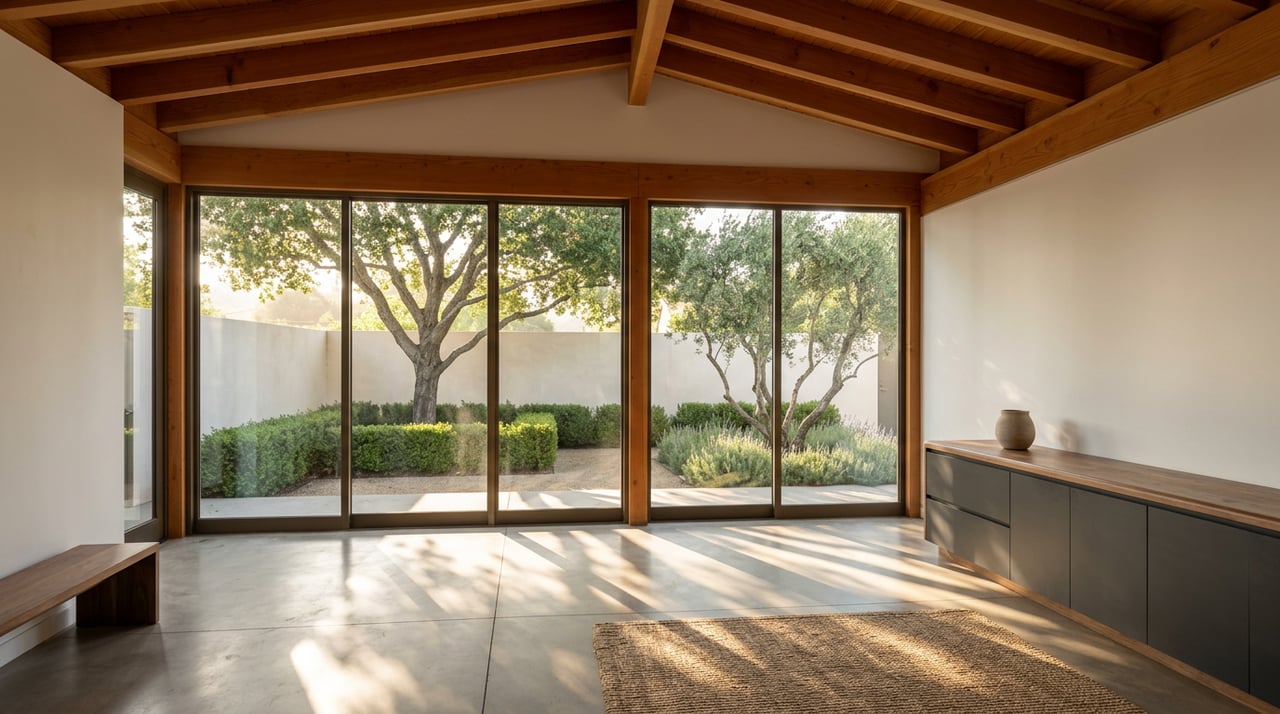
The Inspection Menlo Park's Eichler Buyers Don't Know to Ask For
September 17, 2026
September 17, 2026
A pressure test on a radiant heating system sounds like paperwork. It rarely is. In one exchange on the Eichler Network's own owner forum, a buyer watched a radiant system tested at 9 pounds of pressure lose 1.5 pounds over three hours. The inspection company called it a small leak. The buyer had to decide, mid-escrow, whether "small" was a word he could live with for the next decade, or a signal that the floor of his new house was going to need to come up.
That is the decision Menlo Park's Eichler buyers face, and it rarely shows up on a standard inspection report because the standard inspection was never built to catch it.
Menlo Park's Eichler stock is small enough to describe by address. The city holds roughly 50 of these homes, a fraction of the thousands built in nearby Palo Alto and Sunnyvale, and almost all of them sit in two tracts built two years apart. Stanford Gardens went up in 1950, about a dozen homes clustered on Evergreen and Lemon Streets, an early Eichler project built before the firm settled into its signature architect-driven era. Oakdell Park followed in 1952 and 1953, a slightly larger set of homes on Middle Court, Magnolia Court, Olive Street, and Oakdell Street, designed with input from Jones & Emmons and Anshen + Allen. A smaller, later cluster of Claude Oakland-designed homes sits off Stanford Avenue from the early 1970s, and a handful more are scattered through the Menlo Oaks pocket, which is split between the City of Menlo Park and unincorporated San Mateo County depending on the parcel.
That scarcity matters more than it sounds like it should. In cities where Eichlers number in the thousands, home inspectors and radiant heating technicians see these slabs constantly and know their failure patterns by feel. In Menlo Park, where the entire inventory fits inside two small tracts and a scattering of flag lots, a general inspector may go years without opening up a radiant system here. The home type is rare enough that local familiarity with its one defining mechanical system cannot be assumed the way it can two towns over.
Radiant slab heating runs hot water through tubing embedded directly in the concrete floor, and industry guidance treats roughly 50 years as the system's practical lifespan before failure risk climbs. Do the math against Menlo Park's own build dates. A Stanford Gardens home built in 1950 is carrying a system that, as of this year, is 76 years old. An Oakdell Park home from 1952 or 1953 is at 73 or 74 years. Both figures sit well past the point where industry sources expect these systems to still be running trouble free.
That does not mean every radiant system in these two tracts has failed. Plenty of owners maintain them for decades past that mark. It means the math has already moved against the buyer before an offer is written. A system built in 1950 is not an aging appliance anymore. It is a piece of mechanical infrastructure operating well beyond the window where anyone can promise you it will behave predictably.
Here is the part that catches people off guard: the failure mode is counterintuitive. Radiant heat experts describe slab corrosion as happening from the outside in, not from water sitting inside the pipe. A shower pan or sink that leaks slowly into a crack in the slab is the typical cause, not the water flowing through the tubing itself. That means a visual walkthrough of a kitchen or bathroom tells you almost nothing about the condition of the heating system underneath it. You cannot see a radiant leak. You can only pressure-test for one.
A specialist radiant inspection runs $150 to $300, a separate line item from the general home inspection, which itself averages $511 to $694 across California according to recent industry cost data. Experts in the field recommend testing every one to three years, which is a maintenance rhythm most sellers cannot document going back decades. In practice, that means a Menlo Park Eichler buyer is often the first person in years to actually learn what pressure the system is holding.
Once you have a pressure reading, the next question is what the tubing is made of, because that single fact determines whether a leak is a repair or a replacement.
| Tubing material | Typical outcome when a leak is found | Rough cost range |
|---|---|---|
| Copper | Often repairable, sometimes by reducing system pressure below the standard 12 to 15 psi range | A few thousand dollars or less for a simple fix |
| Steel | Generally not repairable once it starts failing | Tens of thousands for full replacement or conversion to forced air, baseboard, or mini-split systems |
That gap is the entire negotiation. A copper system with a small leak might be a repair bill you fold into closing costs. A steel system in the same condition often means tearing up flooring to access buried piping, which many owners find impractical, and converting to an entirely different heating approach instead. Given that Stanford Gardens and Oakdell Park both date to the early 1950s, when steel tubing was still common in early radiant installations, this is not a hypothetical distinction. It is a question worth asking before you are three weeks into escrow.
Radiant heat is not the only place these homes generate surprises at the closing table. Owners on the Eichler Network's forum have described a separate problem: original fuse boxes paired with knob and tube wiring, a combination that some insurers will not write a policy around without requiring replacement first. One buyer eventually found a carrier willing to insure the home as is, but only after being turned down elsewhere, and insurance has to be in place before a purchase can close.
Menlo Park adds one more layer specific to its geography. Homes in the Menlo Oaks pocket can fall under either the City of Menlo Park or unincorporated San Mateo County jurisdiction depending on the exact parcel, which changes which permitting office you deal with if a radiant conversion or electrical upgrade requires one. It is worth confirming which jurisdiction actually governs a given address before assuming your neighbor's permit timeline will match yours.
None of this is disclosed by default. California's standard seller disclosure form asks for known material facts, not a mechanical history of a 70-year-old heating system, so the burden of finding out generally falls on the buyer's own inspection process.
A few concrete steps change the outcome here, and none of them require walking away from a home you love:
Does every Eichler in Menlo Park still have its original radiant heat? No. Some owners have already converted to baseboard, forced air, or mini-split systems over the decades, particularly where a system failed and repair was not practical. Ask directly rather than assuming either way.
Is a failed radiant system a deal breaker? Not necessarily. It is a cost to budget for, and the size of that cost depends heavily on whether the tubing is copper or steel. A functioning system in good condition is a selling point. A failed one is a known, quantifiable expense rather than an unknown one, as long as you test for it before closing.
Can I get a home warranty to cover a future radiant failure? Coverage varies by provider and by the home's disclosed condition at the time the policy is written, so this is worth confirming directly with a warranty provider rather than assuming standard coverage applies.
If you are weighing a Menlo Park Eichler, or comparing one against other Peninsula properties with more conventional mechanical systems, the details above are the kind of thing worth working through before you are inside a contingency period. Michael Warren Real Estate works this market from the ground up, tract by tract and system by system, and can help you build an offer that accounts for what is actually under the floor. Reach out to Michael Warren Real Estate to request a confidential consultation.
Stay up to date on the latest real estate trends.

Whether it a first-time home buyer or a 10+ Million listing, Michael brings an innovative approach and earns the respect of his clients by working tirelessly on their behalf and always offering candid advice. Contact him today to discuss all your real estate needs!
Connect with Michael.
[email protected]
(650) 315-0224
License #01968537
2930 Woodside Road, Woodside, CA 94062