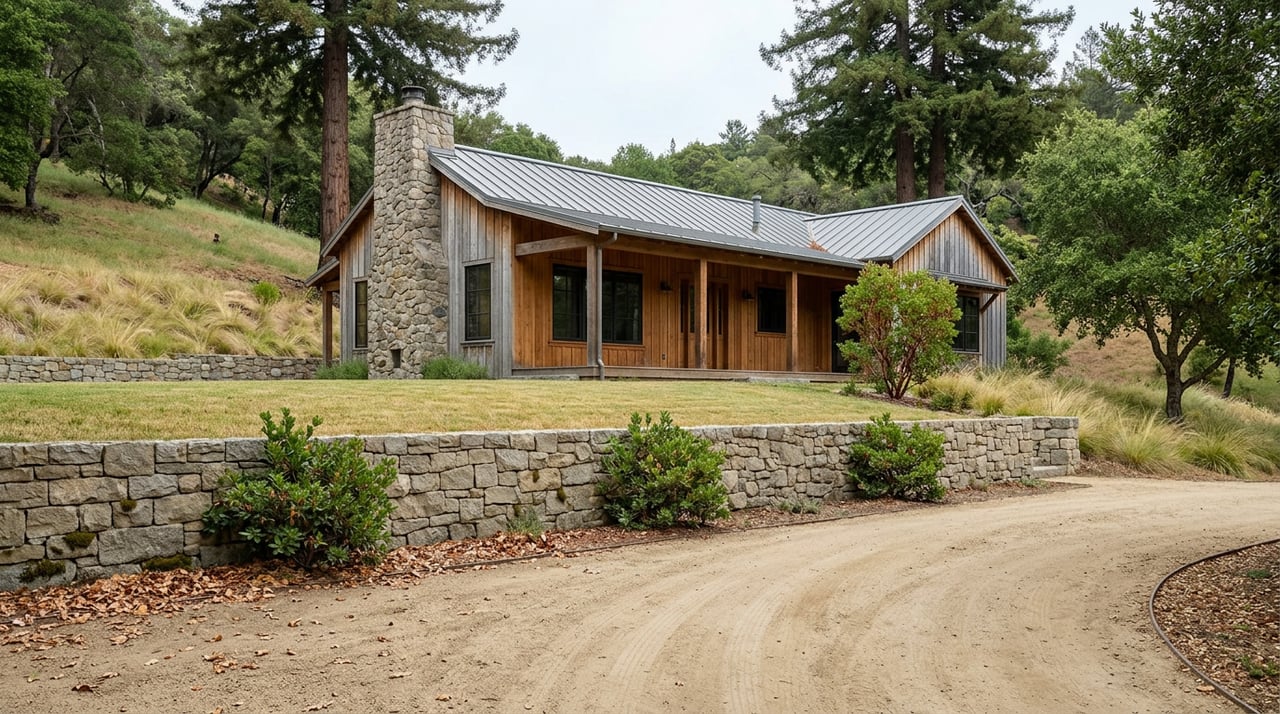
Building a Home in Woodside CA: Zoning and Acreage
August 20, 2026
August 20, 2026
A buyer looks at a 2.8-acre parcel in Woodside and does the math the way anyone would: more land, more house. Then an architect runs the actual zoning calculation and the buildable envelope comes back a fraction of what the acreage suggested. Nothing about the budget changed. The slope did the work.
That gap between what a lot promises on paper and what the Town of Woodside will actually let you build on it is the single most common surprise for buyers moving from municipal-sewer suburbs, whether that's a family upsizing from Menlo Park or a founder relocating from a flatter part of the Peninsula. It has nothing to do with price per square foot, and everything to do with a formula written into the zoning code.
Woodside's development standards tie buildable floor area to something most buyers never think to ask about: net average slope. The Town's own SCP-10 zone handout lays out the tradeoff directly. A parcel with a net average slope between 12.5 and 14.9 percent has to keep at least 32.5 percent of its net acreage in a natural, undeveloped state. Push the slope to 15.0 through 17.4 percent and that natural-state requirement climbs to 40 percent. At 17.5 to 19.9 percent it's 47.5 percent. At 20.0 to 22.4 percent, over half the parcel, 55 percent, has to stay untouched.
Two three-acre listings in the same zone can carry completely different building rights depending on how steep the hillside is. The acreage on the listing is the same number. The buildable acreage is not.
Height is capped in the same document. Any part of a structure that rises above 17 feet from the front setback line has to step back an additional two feet from the property line for every foot of height beyond that. A tall great room or a second story pushed toward a ridgeline doesn't just cost more to engineer. It has to move.
Beyond the slope calculation, Woodside layers on a second gate: a residence-size exception process, and the acreage required to qualify for it varies by zone in ways that surprise even buyers who've done their homework. The Town of Woodside's SCP-5 zone handout and SCP-7.5 zone handout set out the exception thresholds; GoCodebook's summary of Woodside variances and exceptions lists the underlying zone minimums.
| Zone | Underlying zone minimum | Acreage needed to reach the maximum size exception |
|---|---|---|
| SCP-5 | 5 acres | 1.45 acres |
| SCP-7.5 | 7.5 acres | 2.669 acres |
| SCP-10 | 10 acres | 3.68 acres |
The pattern worth sitting with: the acreage threshold for the exception is well below the district's own minimum lot size in every case. A buyer shopping in an SCP-10 area doesn't need the full 10 acres to reach the same size exception available to a full-district parcel. They need 3.68.
And in every one of those three zones, the ceiling on that exception is the same number: 8,800 square feet. Ten acres and 3.68 acres both top out there under the standard exception process. More land past that threshold buys privacy, setback, and a longer driveway. It does not buy a bigger house without a full discretionary variance, which means a public hearing before the Planning Commission and five statutory findings, not a routine sign-off.
Standard single-family (R-1) parcels work on a smaller scale entirely. One Town handout ties a 0.458-acre threshold to a 4,200-square-foot exception. Another ties 0.519 acres to 5,500 square feet, depending on which R-1 subtype and setback table applies to the parcel, including the historic Glens sub-neighborhood, which carries its own rules. A buyer comparing a Glens lot to a rural-estate zoned lot a half mile away isn't just comparing views and privacy. They're comparing two entirely different size ceilings.
Clearing the slope and acreage math doesn't put a shovel in the ground. Most of Woodside has no municipal sewer, which means water and wastewater run through a permitting track that most buyers relocating from a connected suburb have never had to think about.
The Town of Woodside's well submittal requirements say a new well requires a Building Permit and a Site Development Permit from the Town, plus a separate permit from San Mateo County's Office of Environmental Health. The Town of Woodside's Septic System and Percolation Testing Permit Handout says a new or expanded septic system follows a similar dual track: a permit from both the Town and the County, with percolation testing required not just for a brand-new system but for any expansion tied to a net increase in bedrooms. Add a bedroom in a future renovation and the septic capacity question can reopen even on a house that's been standing for decades.
The County's Onsite Systems Manual adds a wrinkle that catches out-of-area buyers off guard: if a property served by septic sits within 200 feet of an available sanitary sewer line, connecting to that sewer becomes mandatory once a major repair or addition to the septic system is proposed. A buyer who assumes they'll keep the existing system indefinitely may find the County has other plans the moment they pull a permit.
Woodside's septic and percolation handout lists the fees that stack on top of the permits themselves: a geology review fee and deposit when the site warrants it, a road impact fee based on cubic yards of imported or exported material once a project moves more than 30 cubic yards of dirt, and construction debris recycling deposits on larger demolition projects. None of these show up on a listing sheet. All of them show up on a construction timeline.
Over the three months ending May 2026, the median sale price for a Woodside home reached $5.2 million, up 11.4 percent from the same period the year before, and the average home sold in just 14 days, down sharply from 38 days the year prior. A market moving that fast rewards buyers who've already done the zoning and permitting homework before they write an offer, not after.
That speed cuts against careful due diligence. A buyer with two weeks to close doesn't have time to discover mid-escrow that the natural-slope requirement eats half the parcel, or that a percolation test hasn't been run in a decade. The buyers who move fastest and with the most confidence are the ones who understood the buildable envelope, the septic history, and the permitting sequence before the property ever came up for offer.
A few questions worth resolving before, not after, you're in contract:
Does a bigger lot always mean a bigger house in Woodside? Not past a certain point. Once a parcel clears the acreage threshold for its zone's maximum size exception, additional acreage buys setback and privacy, not additional square footage, unless the owner pursues a full discretionary variance.
If the house already exists, do these rules still apply? Adding bedrooms or expanding a footprint can trigger fresh percolation testing and floor-area review even on an established home, so the same due diligence applies to renovation plans, not just raw land.
How long does the permitting process actually take? Acton ADU's Woodside overview puts Town review at six to twelve weeks depending on project complexity, and that estimate is before San Mateo County Environmental Health completes its separate septic, well, or geology review, which runs on its own timeline.
Woodside rewards buyers who understand its zoning code as well as they understand its architecture. If you're evaluating acreage, a teardown, or a renovation and want a clear read on what a specific parcel will actually support, Michael Warren Real Estate can walk through the zoning and permitting picture with you before you write an offer, not after. Reach out for a confidential consultation.
This article is general information, not legal, tax or financial advice. Consult a qualified professional about your situation.
Stay up to date on the latest real estate trends.
Whether it a first-time home buyer or a 10+ Million listing, Michael brings an innovative approach and earns the respect of his clients by working tirelessly on their behalf and always offering candid advice. Contact him today to discuss all your real estate needs!
Connect with Michael.
[email protected]
(650) 315-0224
License #01968537
2930 Woodside Road, Woodside, CA 94062