Why Some Menlo Park Lots Could Add a Third Home and Others Couldn't, Until July
August 27, 2026
August 27, 2026
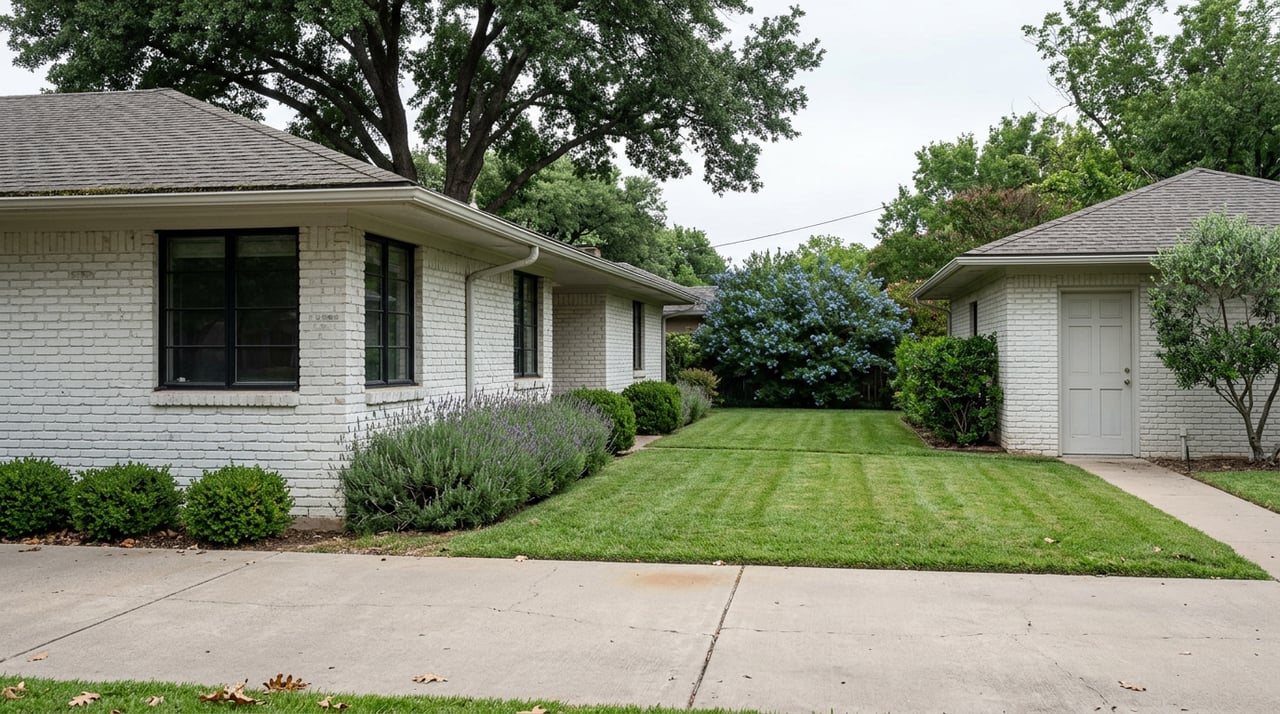
A buyer touring two nearly identical homes on the same Menlo Park block last spring got two very different answers to the same question. Both houses sat on similar-sized lots from the same era. Both had a detached garage in back. On one, the listing agent could point to a legal path for a full accessory dwelling unit, maybe even a rental or a place for aging parents. On the other, the answer was no, and the reason had nothing to do with square footage, height limits, or how far the house sat from the property line. It came down to whether there was room in the driveway for one more parking space.
That distinction just disappeared. On June 9, 2026, the Menlo Park City Council adopted a full rewrite of the city's accessory dwelling unit ordinance, and the new rules took effect July 10, 2026. If you are comparing Menlo Park to other Peninsula towns right now, this is the kind of detail that never shows up in a median price or a portal listing, but it changes what a given parcel is actually worth to build on.
State law has allowed California homeowners to add an ADU, and often a junior ADU on top of that, for years. On paper, most Menlo Park single-family lots have long been eligible for up to three total units: the main house, plus an ADU, plus a JADU. That part was never new.
What was new, and what most homeowners never had reason to look up, was the parking requirement buried in the city's own zoning code. Under the version of Chapter 16.79 that governed the city until this summer, most ADU applications had to provide one off-street parking space, with a narrow list of exemptions (within a half mile of transit, within a historic district, within a block of a car-share vehicle, or if the ADU sat entirely inside the existing home). On a large Sharon Heights or Menlo Oaks lot with a wide driveway, that requirement was an afterthought. On a narrower lot in the flats, especially one where the driveway already served the main house and left no room for a second stall, it could quietly rule out an entire ADU project before a homeowner ever got to floor plans.
That is the mechanism worth understanding. The theoretical right to build a third unit and the practical ability to build one were two different things, and the gap between them tracked lot geometry more than lot size.
The Planning Commission recommended eliminating the parking requirement and loosening the floor-area rules back in April, ahead of a May 19 City Council introduction, and the council carried both changes through to final adoption in June. The rewrite also dropped a reference to vacation rentals from the ordinance's rental-term language, closing off a possible short-term-rental use for these units. By late June, the city had submitted the new ordinance to the state's Housing and Community Development department for the mandatory 60-day review, and HCD confirmed it had no comments and required no amendments, which means the rule is now settled rather than pending.
The city's own description of the process is worth knowing too: ADU applications that meet the zoning ordinance's requirements can be reviewed and approved by staff, without a discretionary hearing. That has not changed. What changed is how many lots now clear that bar without needing a parking variance or a use permit to get there.
None of this means every backyard should have a cottage in it. The math still has to work, and the three unit types carry different costs and constraints.
| Unit type | Size cap | Parking (post-July 2026) | Rough cost range |
|---|---|---|---|
| JADU (inside the existing home) | Up to 500 sq ft | None required | Lowest, limited to interior conversion |
| Attached or interior ADU | Up to 1,000 sq ft or 50% of the primary home, whichever is greater | None required | Mid-range, depends on existing structure |
| Detached ADU | Up to 1,000 sq ft | None required | Roughly $450 to $600 per square foot for new construction |
At that per-square-foot range, a full 1,000-square-foot detached unit runs somewhere between $450,000 and $600,000 before design fees, permits, or site work like utility trenching. For homeowners in west Menlo Park considering this purely as an investment, that cost has to be weighed against either rental income or the resale premium a legal accessory unit adds, not against the abstract fact that the city now allows it. Menlo Park does exempt ADUs under 750 square feet from certain city impact fees, which narrows the gap for a smaller unit, though plan check, inspection, and utility fees still apply and school district fees can as well.
There are practical wrinkles beyond the ordinance too. Most of the city is served by West Bay Sanitary District, and a new ADU can trigger a requirement for an upgraded sewer lateral or a capacity check, which is not a city planning issue but a separate call to make before finalizing a design. PG&E service and panel capacity is another line item that adds time on older properties. None of this is exotic, but it is the kind of homework that separates a lot that is legally eligible from one that is actually ready to build on this year.
A May 2026 guest opinion in The Almanac made a related point about the broader Peninsula market: headline prices are starting to hide more than they reveal. The piece noted that in the first quarter of 2026, Atherton's single-family closings fell by roughly 52% year over year on just 32 new listings, yet the median sale price held near $7.4 million because the transactions that did close skewed toward the very top of the market. Menlo Park moved in the opposite direction over the same period, with closings up about 50% and new listings up nearly 39%, while the median price slipped about 2%. The author's broader argument was that comparable sales are getting harder to find and the visible data is increasingly skewed toward the extremes, which complicates everything from a routine refinance to an ADU feasibility study.
That is the same problem this ordinance change creates on a smaller scale. Two Menlo Park listings can carry the same asking price and the same square footage while one of them quietly comes with the ability to add $450,000 to $600,000 worth of legally rentable or livable space and the other does not. A median tells you nothing about which one you are looking at. The only way to know is to ask whether the specific lot has the setback room, the utility capacity, and now, since parking is off the table as an obstacle, whether anything else on that parcel would have blocked an ADU before this summer.
If you are comparing homes in Menlo Park against other Mid-Peninsula towns, the ADU question is worth raising directly with the listing agent rather than assuming the answer from the lot size alone. Ask whether a feasibility check has been run against the current, post-July ordinance, not an older one. Ask about the sewer lateral and panel capacity, since those can add real cost even when the zoning is clear. And if the appeal of a property includes multi-generational living or future rental flexibility, get the floor-area math in writing before you factor that value into your offer.
Does the parking change apply retroactively to a project that already has permits under the old ordinance? The June rewrite governs applications submitted after the July 10, 2026 effective date. Projects already in process under the prior ordinance would need to check with city planning staff on which rules apply to their specific application.
Do I still need to keep at least one parking space for my own use? The ordinance removed the requirement to provide a dedicated space for the ADU itself. It does not restrict how you use your own driveway or garage for your primary residence.
Is a JADU or an attached ADU still my only option if my lot is narrow? Not necessarily. Since the parking requirement is gone, a narrow lot that previously failed on that basis alone may now qualify for a detached unit, subject to the same setback and floor-area rules that apply to any ADU.
Menlo Park's zoning code did not get easier to read this year, but it did get easier to build under, and that difference is worth more to a specific buyer or seller than any citywide average. If you are weighing a Menlo Park property against something in Atherton, Woodside, or Portola Valley and want a straight read on what a particular lot's third-unit potential is actually worth, Michael Warren Real Estate can walk the parcel with you and put real numbers behind the question before you write an offer.
Stay up to date on the latest real estate trends.
Whether it a first-time home buyer or a 10+ Million listing, Michael brings an innovative approach and earns the respect of his clients by working tirelessly on their behalf and always offering candid advice. Contact him today to discuss all your real estate needs!
Connect with Michael.
[email protected]
(650) 315-0224
License #01968537
2930 Woodside Road, Woodside, CA 94062